How to Select the Right Fan for Your Application
Selecting an industrial fan involves more than choosing the correct size or comparing maximum airflow.
A fan operates as part of a complete system. Filters, heat exchangers, ducts, enclosures and other components create resistance that affects the actual airflow delivered by the fan.
For this reason, proper fan selection should consider airflow, static pressure, fan type, power supply, installation space and operating conditions together.
Understanding these factors can help engineers select a fan that better matches the actual requirements of their equipment.
1. Determine the Required Airflow
The first step is to determine how much air the application needs.
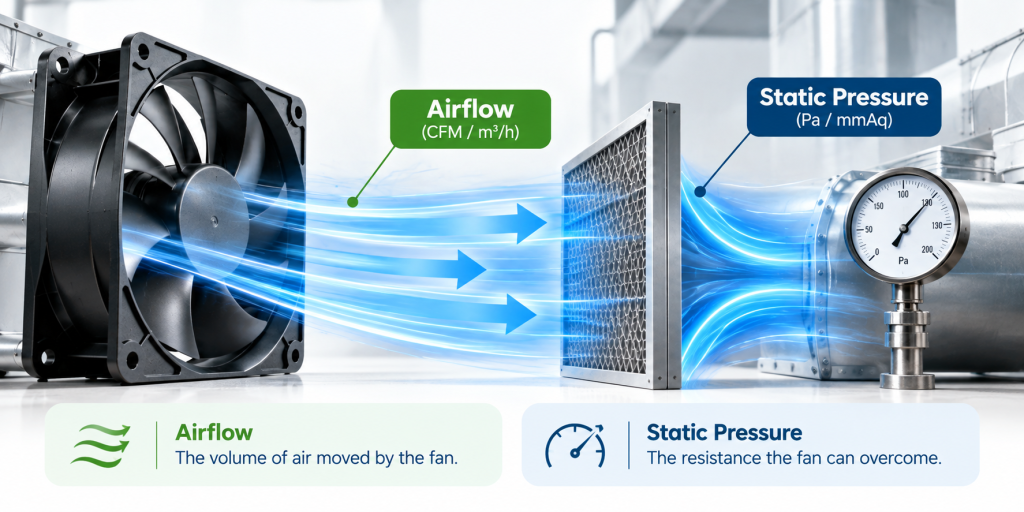
Airflow describes the volume of air moved by a fan over a given period of time and is commonly expressed in:
- CFM (Cubic Feet per Minute)
- m³/h (Cubic Meters per Hour)
The required airflow depends on the application.
For equipment cooling, airflow may be determined by factors such as heat generation, allowable temperature rise and enclosure design.
For ventilation systems, the requirement may depend on the volume of the space and the desired air exchange rate.
However, maximum airflow alone should not be used to select a fan.
2. Determine the Required Static Pressure
Once the airflow requirement is understood, the next consideration is static pressure.
Air moving through a real system encounters resistance from components such as:
- Filters
- Heat exchangers
- Grilles
- Ducts
- Internal equipment structures
- Restricted air inlets and outlets
As system resistance increases, the actual airflow produced by the fan may decrease.
Therefore, the required operating point should consider both airflow and static pressure.
A fan capable of producing high free-air airflow may not necessarily deliver the required airflow when installed in a restrictive system.
3. Review the Fan Performance Curve
A fan performance curve shows the relationship between airflow and static pressure.
Typically, airflow decreases as the pressure requirement increases.
The system itself also has a resistance curve. The point where the fan performance curve and the system resistance curve intersect is known as the operating point.
This operating point provides a more realistic indication of how the fan will perform after installation.
For this reason, comparing fan curves is often more useful than comparing maximum airflow specifications alone.
4. Select the Appropriate Fan Type
Different fan designs are suitable for different operating conditions.
Axial Fans
Axial fans generally provide high airflow in applications with relatively low to moderate system resistance.
They are commonly used for:
- Equipment cooling
- Cabinet ventilation
- HVAC systems
- Machinery cooling
- General ventilation
Centrifugal Fans
Centrifugal fans are often used when higher static pressure is required.
They are suitable for applications involving:
- Filters
- Heat exchangers
- Duct systems
- Air handling equipment
- Restricted airflow paths
The correct choice depends on the airflow and pressure requirements of the actual system.
5. Choose the Motor Technology
Industrial fans may use AC, DC or EC motor technologies.
AC Fans
AC fans can operate directly from an AC power supply and are widely used in industrial equipment and ventilation applications.
They are often selected where simple and reliable operation is required.
DC Fans
DC fans operate from a DC power source and are commonly used in electronic equipment, control systems and other applications where low-voltage DC power is available.
Depending on the fan design, DC technology can also provide flexible speed control.
EC Fans
EC fans combine electronically controlled motor technology with an AC power input.
They can provide high efficiency and flexible speed control, making them suitable for applications where energy efficiency and system control are important considerations.
The appropriate motor technology depends on the available power supply, control requirements and overall system design.
6. Check Installation Space and Dimensions
Physical dimensions are another important part of fan selection.
Consider:
- Fan diameter or frame size
- Fan depth
- Mounting dimensions
- Air inlet and outlet clearance
- Installation orientation
- Available space inside the equipment
A fan may provide the required performance but still be unsuitable if it cannot be properly integrated into the equipment.
Adequate clearance around the inlet and outlet is also important because restricted airflow can affect fan performance.
7. Consider Noise Requirements
Noise may be an important consideration depending on the application.
Fan noise can be influenced by several factors, including:
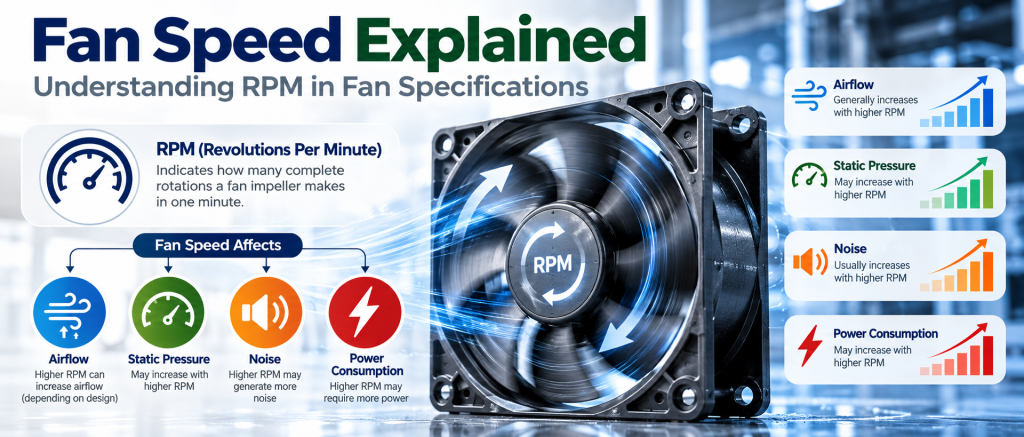
- Fan speed
- Impeller design
- Airflow velocity
- System resistance
- Installation conditions
- Turbulence near the fan inlet or outlet
Selecting a larger fan operating at a lower speed may sometimes help reduce noise while maintaining the required airflow, although the actual result depends on the system design.
Noise specifications should therefore be evaluated together with airflow and pressure requirements.
8. Consider the Operating Environment
Industrial fans may operate under very different environmental conditions.
Important factors can include:
- Ambient temperature
- Humidity
- Dust
- Installation location
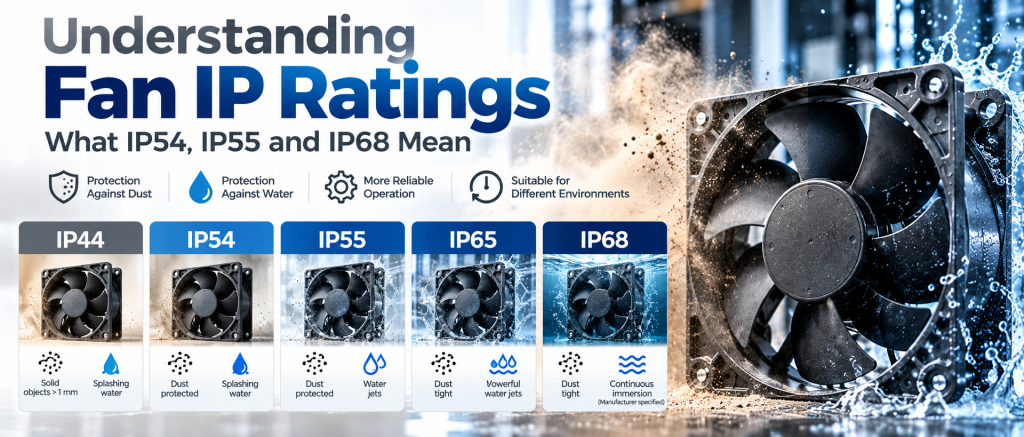
- Required protection level
- Continuous or intermittent operation
The selected fan should be suitable for the environmental conditions expected in the application.
For demanding environments, additional protection or a different fan construction may be required.
9. Consider Speed Control and System Integration
Some applications require the fan speed to change according to system demand.
Variable-speed operation can help adjust airflow, reduce unnecessary energy consumption and support more precise system control.
Depending on the fan and motor technology, control methods may include different electrical or electronic control solutions.
When speed control is required, the control method should be considered during the initial fan selection process rather than added only after the fan has been selected.
10. Evaluate the Complete System
The best fan is not necessarily the model with the highest airflow, highest speed or largest motor.
The goal is to select a fan that operates effectively under the actual conditions of the equipment.
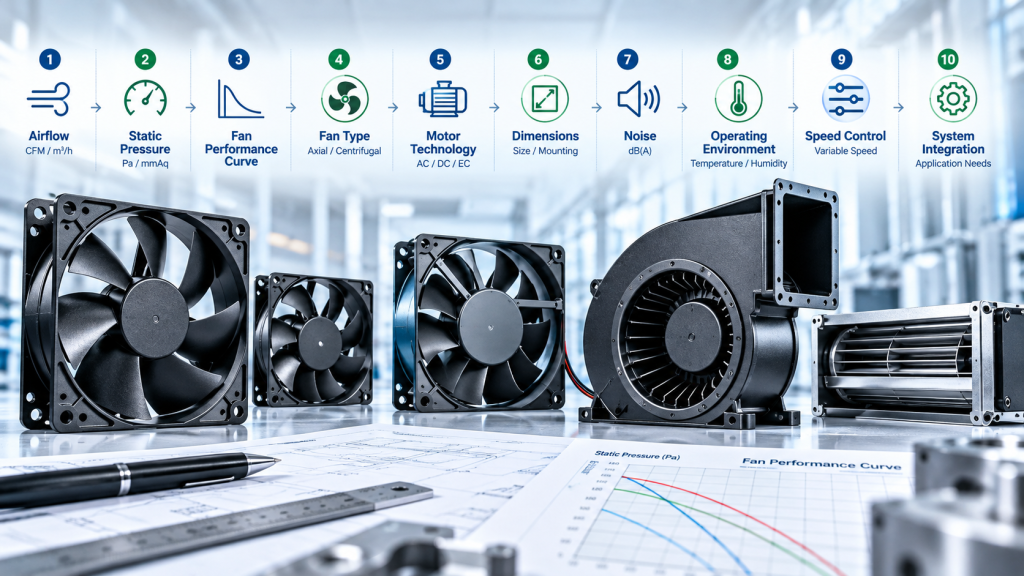
Before selecting a fan, consider the complete set of requirements:
- Airflow
- Static pressure
- Fan performance curve
- Fan type
- AC, DC or EC motor technology
- Voltage
- Dimensions
- Noise
- Ambient temperature
- Speed control
- Installation conditions
Evaluating these factors together provides a better basis for selecting a reliable fan solution.
Finding the Right Fan Solution
Every application has different airflow, pressure, space and control requirements.
For some equipment, a standard fan may provide the required performance. Other applications may require a different fan type, motor technology or customized solution to match the operating conditions.
HEYU Technology provides AC, DC and EC fan solutions, including axial fans, centrifugal fans and blowers for industrial cooling and ventilation applications.
If you are selecting a fan for new equipment or looking for an alternative solution for an existing application, share your required airflow, static pressure, dimensions, voltage and operating conditions with us.
Our team can help evaluate suitable fan solutions based on your application requirements.