Fan Speed Explained: Understanding RPM in Fan Specifications
When comparing industrial fans, fan speed RPM is one of the most common specifications shown in a datasheet. RPM indicates how fast the fan rotates, but a higher RPM does not automatically mean that a fan is better for an application.
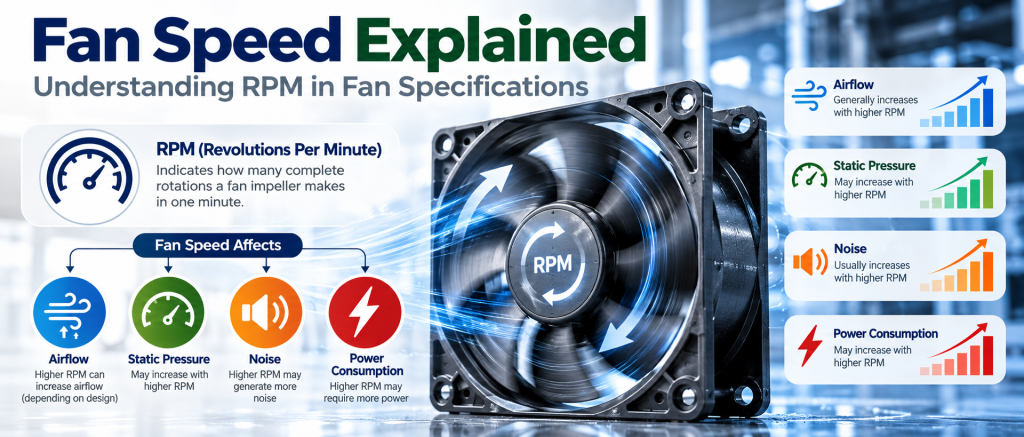
Fan speed affects several aspects of fan performance, including airflow, static pressure, noise and power consumption. Understanding RPM can therefore help engineers evaluate fan specifications more effectively and select a suitable fan for their equipment.
What Does RPM Mean?
RPM stands for Revolutions Per Minute. It indicates how many complete rotations a fan impeller makes in one minute.
For example, a fan operating at 1,500 RPM completes approximately 1,500 revolutions every minute.
Industrial fans can operate at very different speeds depending on their size, motor design, impeller geometry and intended application.
RPM should therefore be considered as one part of the overall fan specification rather than as an independent measure of performance.
Does Higher RPM Mean More Airflow?
In general, increasing fan speed can increase airflow when comparing the same fan operating under similar conditions.
However, this does not mean that a higher-RPM fan will always provide more airflow than another fan.
Fan diameter, blade geometry, impeller design, motor characteristics and system resistance all influence actual airflow performance.
For example, a larger fan operating at a lower speed may provide more airflow than a smaller fan operating at a significantly higher speed.
This is why airflow specifications and fan performance curves should be considered together with RPM.
How Fan Speed Affects Static Pressure
Fan speed can also influence the static pressure a fan is capable of generating.
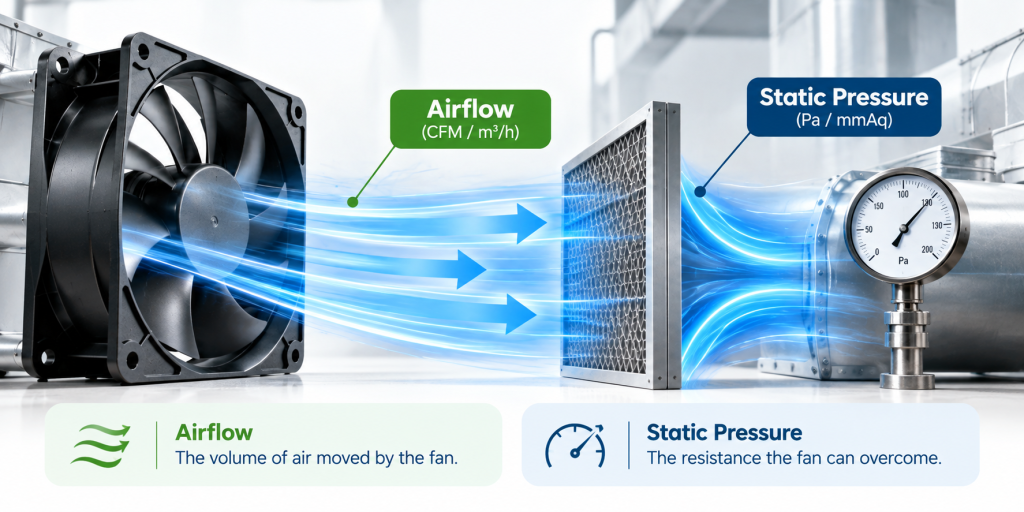
Static pressure represents the fan’s ability to move air against resistance within a system.
Common sources of resistance include:
- Filters
- Heat exchangers
- Ductwork
- Grilles and guards
- Internal equipment components
- Restricted air passages
Increasing fan speed may help generate additional pressure, but the actual operating result depends on the fan design and the resistance of the system.
For applications with significant airflow resistance, simply selecting the highest-RPM fan may not provide the best solution.
Fan Speed and Noise
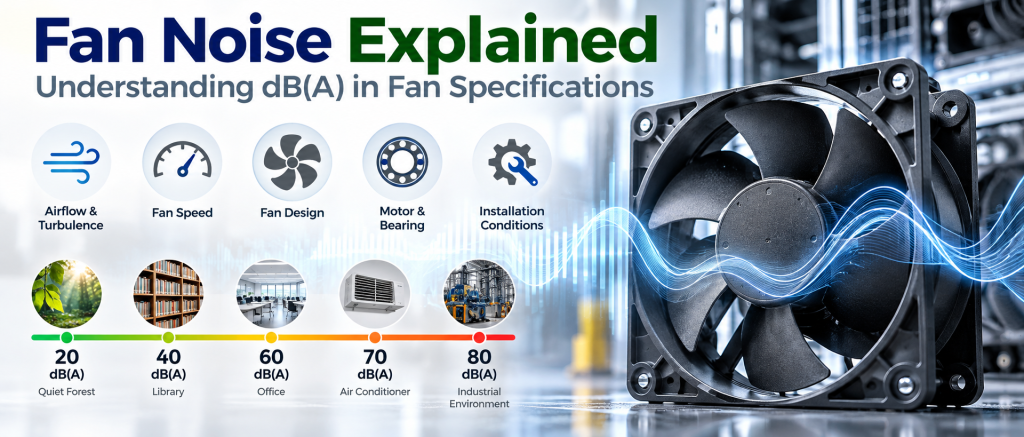
One of the most noticeable effects of increasing fan speed is often an increase in noise.
As the impeller rotates faster, aerodynamic turbulence and mechanical effects can become more significant.
This means that a high-speed fan may provide additional airflow or pressure but may also generate a higher sound level.
For noise-sensitive applications, engineers may consider using a larger fan operating at a lower speed if space and system requirements allow.
This can sometimes provide the required airflow while maintaining more suitable acoustic performance.
Fan Speed and Power Consumption
Changing fan speed can also affect the power required to operate the fan.
As speed increases, the motor may require more power to maintain the higher rotational speed and overcome system resistance.
The exact relationship depends on the fan design, motor technology and operating conditions.
For this reason, fan speed should be considered together with electrical specifications such as:
- Voltage
- Current
- Input power
- Motor efficiency
- Speed control method
This becomes particularly important in equipment designed for continuous operation.
Why Two Fans with the Same RPM Can Perform Differently
RPM alone cannot be used to compare the performance of two different fan models.
Two fans operating at the same rotational speed may have significantly different airflow and static pressure characteristics.
Differences may result from:
- Fan diameter
- Blade shape
- Blade angle
- Number of blades
- Impeller design
- Motor characteristics
- Fan housing
- Inlet and outlet geometry
Therefore, comparing only RPM can lead to an incorrect fan selection.
The complete performance data should always be evaluated.
What Is Variable Speed Control?
Some fan systems allow rotational speed to be adjusted according to operating requirements.
Variable speed control can help match fan output to changing system demand.
Depending on the fan and motor technology, speed control may be achieved through different control methods.
This can be useful in applications where cooling or ventilation demand changes during operation.
Instead of operating continuously at maximum speed, the fan can potentially operate at a lower speed when full performance is not required.
This may help balance airflow performance, noise and energy consumption.
AC, DC and EC Fans and Speed Control
Different motor technologies may provide different speed-control characteristics.
AC fans are commonly used in industrial ventilation and equipment cooling where direct AC power and reliable operation are required.
DC fans are widely used in electronic equipment and systems where low-voltage DC power and flexible control may be important.
EC fans combine electronically controlled motor technology with efficient operation and can support variable-speed solutions depending on the specific design.
The appropriate technology depends on the power supply, control requirements and operating conditions of the application.
RPM Should Be Evaluated with the Fan Curve
The most useful way to understand fan performance is not to look at RPM alone, but to evaluate it together with the fan performance curve.
A fan curve shows the relationship between airflow and static pressure.
When the resistance of the actual system is considered, the intersection between the fan curve and system curve determines the operating point.
This operating point provides a more meaningful indication of how the fan will perform after installation.
RPM is therefore an important specification, but it is only one part of the complete fan selection process.
How to Compare Fan Speed Specifications
When comparing industrial fans, consider RPM together with:
- Airflow
- Static pressure
- Fan performance curve
- Noise level
- Input power
- Fan dimensions
- Motor technology
- Operating environment
- Speed control requirements
A higher speed may be beneficial in some applications, while a lower-speed solution may provide better acoustic or efficiency characteristics in others.
The appropriate choice depends on the actual requirements of the equipment.
Conclusion
Fan speed is an important specification, but higher RPM does not automatically mean better fan performance.
RPM should be evaluated together with airflow, static pressure, noise, power consumption, fan dimensions and the actual resistance of the system.
For industrial equipment, the objective is to select a fan that provides the required performance at an appropriate operating point rather than simply selecting the highest-speed model.
HEYU Technology provides AC, DC and EC fan solutions for a wide range of industrial equipment and ventilation applications.
If you are evaluating a fan for a specific application, share your airflow, static pressure, dimensions, voltage, speed and operating requirements with us. Our team can help evaluate suitable fan solutions based on your application needs.