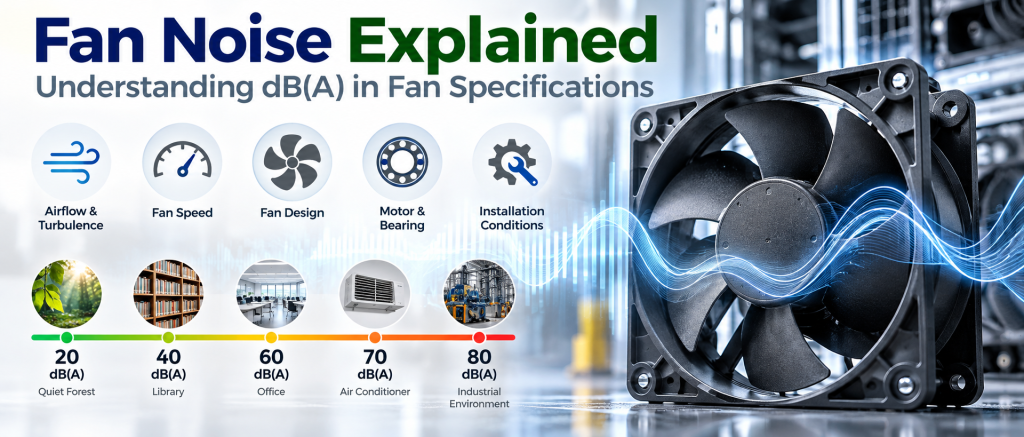
Fan Noise Explained: Understanding dB(A) in Fan Specifications
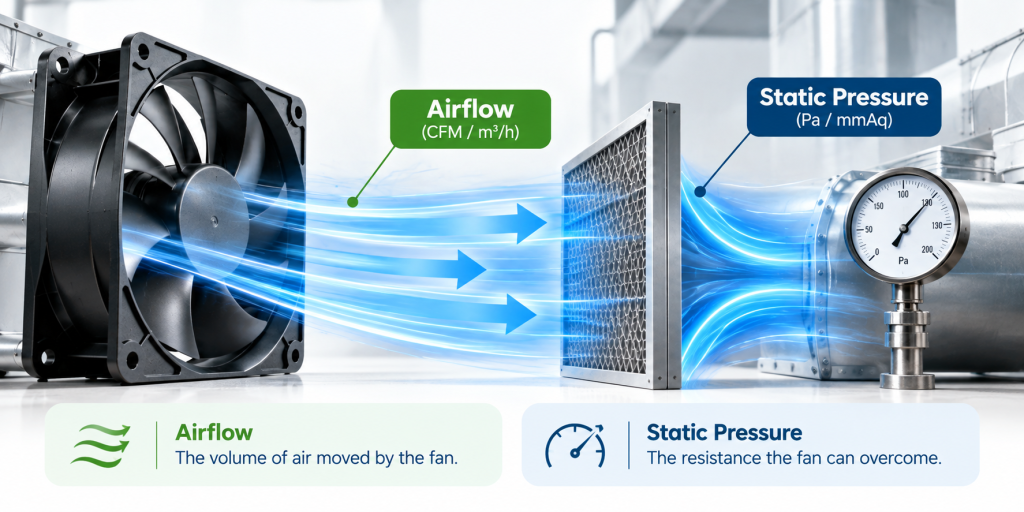
When selecting an industrial fan, airflow and static pressure are often the first specifications engineers consider. However, noise can also be an important factor, especially when fans are installed in equipment operating near people or in noise-sensitive environments.
Fan noise is commonly expressed in dB(A). Understanding what this value means—and what affects it—can help engineers compare fan options and make better decisions for their applications.
What Is dB(A)?
Sound level is measured in decibels (dB). However, the human ear does not respond equally to all sound frequencies.
For this reason, fan noise specifications are often expressed as dB(A). The “A” refers to A-weighting, a method that adjusts measured sound levels to better reflect how the human ear perceives different frequencies.
In practical terms, dB(A) provides a useful way to compare the perceived noise levels of different fans under specified test conditions.
Why Fan Noise Matters
Noise may not be a major concern in every industrial application. In some equipment, airflow performance, cooling capacity or reliability may be more important.
However, noise becomes more important when fans are used in applications such as:
- HVAC equipment
- Air purification systems
- Medical equipment
- Telecommunications equipment
- Electronic cabinets
- Commercial equipment
- Equipment installed near occupied areas
In these applications, selecting a fan with appropriate acoustic performance can contribute to better overall system design.
How Does the Decibel Scale Work?
One important point about fan noise is that the decibel scale is logarithmic, not linear.
This means that a difference of several decibels should not be interpreted simply as the same percentage increase or decrease in perceived loudness.
For example, two fans rated at 40 dB(A) and 50 dB(A) do not differ by only 25% in acoustic terms.
This is why dB(A) values should be considered carefully when comparing fan specifications.
What Causes Fan Noise?
Fan noise can come from several sources.
1. Airflow and Turbulence
As fan blades move air, turbulence can generate aerodynamic noise.
Restrictions near the fan inlet or outlet—including guards, filters, heat exchangers and poorly designed openings—may increase turbulence and affect the overall noise level.
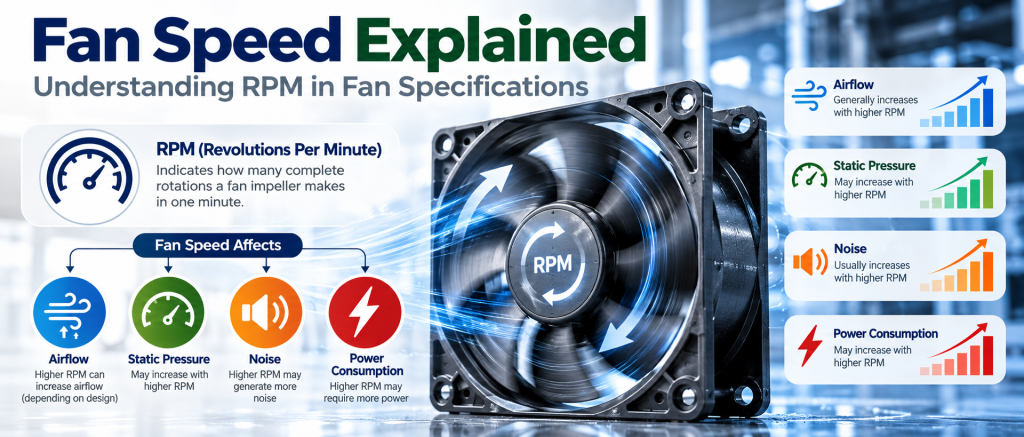
2. Fan Speed
Fan rotational speed is another important factor.
In general, increasing fan speed can increase airflow, but it can also increase noise. This is one reason why selecting an appropriately sized fan can be preferable to simply operating a smaller fan at very high speed.
3. Blade and Impeller Design
Blade geometry, blade count, impeller diameter and aerodynamic design can all influence acoustic performance.
Different fan designs may therefore produce different noise characteristics even when their airflow specifications appear similar.
4. Motor and Bearing Noise
Mechanical components can also contribute to the overall sound generated by a fan.
Motor design, bearing type, rotational speed and component quality may affect mechanical noise and vibration.
This is particularly relevant when evaluating long-term operation and equipment reliability.
5. Installation Conditions
A fan does not operate independently from the equipment around it.
Mounting structure, enclosure design, airflow restrictions and nearby components can all affect the noise measured after the fan is installed.
As a result, the actual sound level of a complete system may differ from the fan manufacturer’s specified value.
Fan Noise and Operating Conditions
A noise value listed in a fan specification should be understood as a value measured under defined test conditions.
The actual noise level in an application may change depending on factors such as:
- Operating voltage
- Fan speed
- System resistance
- Installation position
- Airflow restrictions
- Distance from the fan
- Surrounding structure
- Acoustic characteristics of the environment
For this reason, comparing dB(A) values is most meaningful when the fans are evaluated under comparable conditions.
Lower Noise Does Not Always Mean a Better Fan
It may be tempting to select the fan with the lowest noise specification. However, fan selection should always consider the complete operating requirement.
A lower-noise fan may also provide lower airflow or different static pressure performance.
The objective is therefore not simply to find the quietest fan, but to find a fan that provides the required airflow, static pressure, reliability and acoustic performance for the application.
How to Reduce Fan Noise in an Application
There are several ways engineers can approach fan noise reduction.
First, select a fan that can provide the required airflow and static pressure without operating unnecessarily close to its maximum capability.
Second, reduce unnecessary airflow restrictions around the inlet and outlet whenever possible.
Proper fan sizing may also allow the system to operate at a lower rotational speed.
For applications requiring variable performance, speed control can provide another way to balance airflow demand, energy consumption and acoustic performance.
Finally, mechanical mounting and system structure should also be considered because vibration can contribute to overall equipment noise.
Consider Noise Together with the Fan Performance Curve
Noise should not be evaluated separately from airflow and static pressure.
The actual operating condition of a fan is determined by the interaction between the fan performance curve and the resistance of the system.
Understanding the operating point helps engineers determine whether the selected fan can provide the required airflow while maintaining acceptable noise and efficiency.
This is why fan selection should consider multiple specifications together rather than focusing on a single value.
Selecting the Right Fan for Your Application
When comparing industrial fans, consider noise together with:
- Airflow
- Static pressure
- Fan performance curve
- Fan type
- Motor technology
- Dimensions
- Operating environment
- Bearing type
- Speed control requirements
- System integration
The appropriate balance depends on the actual requirements of the equipment.
Conclusion
Fan noise is an important part of industrial fan selection, particularly for equipment operating near people or in applications where acoustic performance matters.
Understanding dB(A) and the factors that influence fan noise can help engineers make more meaningful comparisons between different fan options.
The best fan is not necessarily the fan with the lowest noise level. It is the fan that provides the appropriate balance of airflow, static pressure, noise, reliability and system compatibility for the application.
HEYU Technology provides AC, DC and EC fan solutions for a wide range of industrial equipment and ventilation applications.
If you are evaluating a fan for a specific application, share your airflow, static pressure, dimensions, voltage, noise and operating requirements with us. Our team can help evaluate suitable fan solutions based on your application needs.