What Does IP Rating Mean for Industrial Fans?
When selecting an industrial fan, airflow, static pressure, voltage and dimensions are usually among the first specifications engineers consider. However, the operating environment is equally important.
Industrial fans may be exposed to dust, moisture, water or other environmental conditions that can affect reliability and service life. This is where the IP rating for industrial fans becomes an important consideration.
Understanding IP ratings can help engineers select a fan with an appropriate level of protection for the actual operating environment.
What Is an IP Rating?
IP stands for Ingress Protection.
An IP rating indicates the level of protection provided by an enclosure against the entry of solid objects and water.
The rating normally consists of the letters IP followed by two digits, such as:
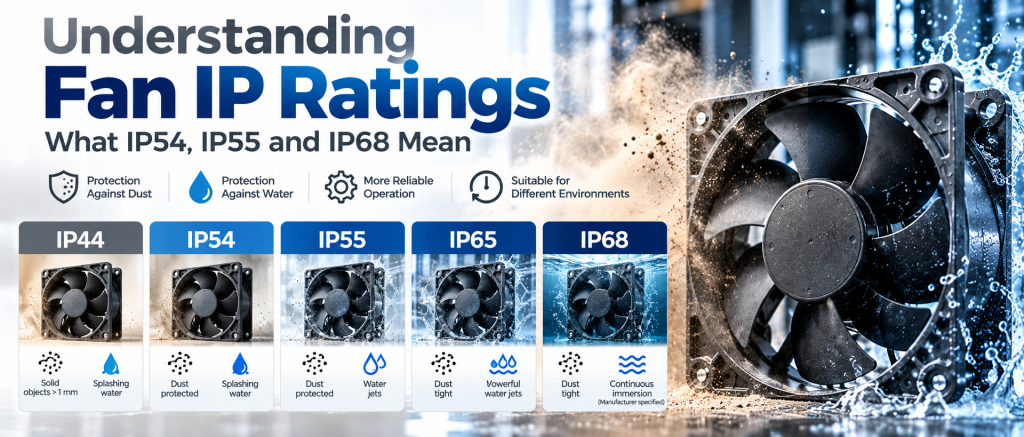
IP44
IP54
IP55
IP65
Each digit represents a different type of protection.
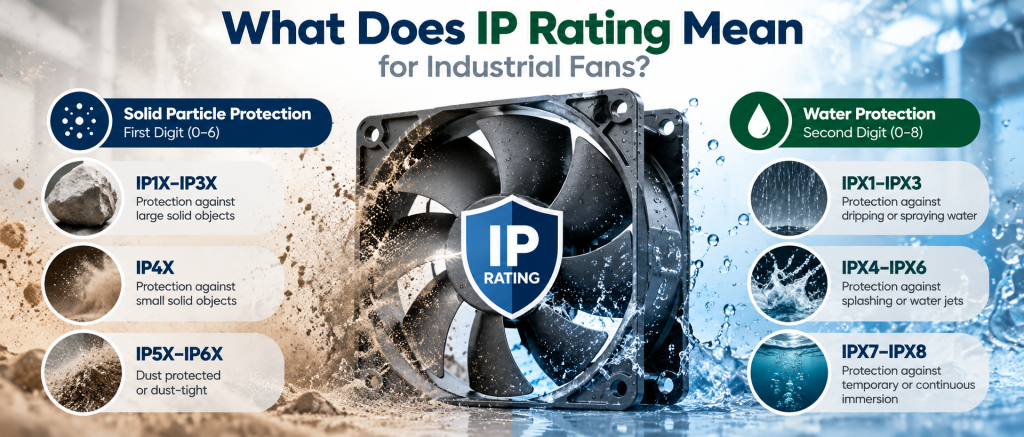
The first digit indicates protection against solid objects and dust, while the second digit indicates protection against water.
Understanding these two numbers makes it easier to evaluate whether a fan is suitable for a particular operating environment.
How to Read an IP Code
Consider IP54 as an example.
The first digit, 5, represents the level of protection against solid particles and dust.
The second digit, 4, represents the level of protection against water.
Therefore, IP54 does not simply mean that a product is “waterproof.” It describes two separate protection characteristics.
This distinction is important when comparing industrial fans for different applications.
What Does the First Digit Mean?
The first digit describes protection against solid foreign objects.
In general, a higher number indicates a higher level of protection.
| First Digit | General Protection Level |
|---|---|
| 0 | No protection |
| 1 | Protection against large solid objects |
| 2 | Protection against finger-sized objects |
| 3 | Protection against larger tools and wires |
| 4 | Protection against small solid objects |
| 5 | Dust protected |
| 6 | Dust-tight |
For industrial equipment, dust protection can be particularly important in environments where airborne particles may enter the fan or surrounding equipment.
What Does the Second Digit Mean?
The second digit describes protection against water ingress.
Again, a higher number generally represents a higher level of protection under the defined test conditions.
| Second Digit | General Protection Level |
|---|---|
| 0 | No protection |
| 1 | Protection against vertically dripping water |
| 2 | Protection against dripping water at an angle |
| 3 | Protection against spraying water |
| 4 | Protection against splashing water |
| 5 | Protection against water jets |
| 6 | Protection against powerful water jets |
| 7 | Protection against temporary immersion |
| 8 | Protection under specified continuous immersion conditions |
The required level depends on where and how the fan will be installed.
A fan installed inside protected electrical equipment, for example, may have very different requirements from one used in an environment exposed to moisture or water.
Common IP Ratings for Industrial Fans
There is no single IP rating that is suitable for every industrial fan application.
Different fan designs and applications require different levels of environmental protection.
For example, an industrial fan may be installed inside:
- Electrical cabinets
- HVAC equipment
- Industrial machinery
- Ventilation systems
- Energy storage equipment
- Telecommunications equipment
- Outdoor equipment
The appropriate IP rating should therefore be determined according to the actual installation environment and system requirements.
Choosing the highest available IP rating is not automatically the best solution. The objective is to select a fan that provides the necessary protection while meeting the other performance requirements of the system.
Why IP Rating Matters in Fan Selection
Environmental conditions can have a significant effect on fan reliability.
Dust accumulation may interfere with moving components or restrict airflow. Moisture may affect electrical components, connections or other parts of the system.
For this reason, engineers should consider the installation environment early in the fan selection process.
Important questions may include:
Will the fan operate in a dusty environment?
Will the fan be exposed to splashing or spraying water?
Is the fan installed inside another protective enclosure?
Will the equipment be used indoors or outdoors?
Are there specific environmental requirements for the application?
These questions help determine the level of ingress protection required.
IP Rating Is Not the Only Selection Factor
Although IP rating is important, it should not be considered independently from other fan specifications.
A suitable industrial fan must also meet the required operating conditions.
Important parameters include:
- Airflow
- Static pressure
- Fan performance curve
- Fan type
- Voltage and motor technology
- Dimensions and mounting
- Noise requirements
- Operating temperature
- Speed control requirements
- Bearing type
For example, a fan with a high IP rating may provide excellent environmental protection, but it is still unsuitable if it cannot provide the required airflow or static pressure.
Fan selection should therefore consider the complete system rather than a single specification.
Choosing the Right Fan for Your Application
The IP rating for industrial fans should be selected according to the actual operating environment rather than simply choosing the highest available rating.
Understanding the protection required against dust and water can help engineers identify a more appropriate fan solution while considering airflow, static pressure, dimensions, voltage and other system requirements.
HEYU Technology provides AC, DC and EC fan solutions for a wide range of industrial cooling and ventilation applications.
If you are unsure which fan is suitable for your equipment, share your airflow, static pressure, dimensions, voltage and operating environment requirements with us. Our team can help evaluate suitable fan solutions based on your application needs.