AC vs. DC vs. EC Fans: What’s the Difference?
Choosing the right fan involves more than selecting the correct size and airflow. The type of motor technology can also affect efficiency, speed control, power consumption and system integration.
AC, DC and EC fans are widely used in cooling, ventilation and industrial equipment, but each technology has different characteristics and advantages.
Understanding the differences between AC, DC and EC fans can help engineers select a fan solution that better matches the requirements of their application.
What Is an AC Fan?
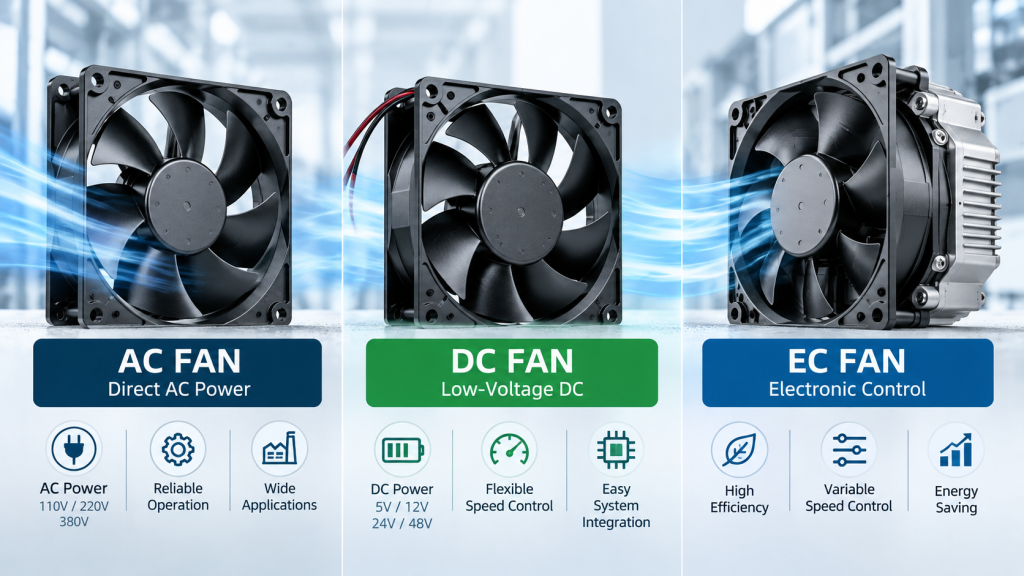
An AC fan operates using alternating current (AC) power. These fans are commonly connected directly to standard AC power sources such as 110 V, 220–230 V or 380–400 V, depending on the motor design and application.
AC fans are widely used in industrial ventilation, machinery cooling, HVAC equipment and other applications where a simple and reliable ventilation solution is required.
One of the main advantages of AC fans is their straightforward power connection. In many applications, they can operate directly from the available AC power supply without requiring a separate DC power source.
Typical characteristics of AC fans include:
- Direct operation from AC power
- Simple system integration
- Reliable operation
- Wide availability of sizes and configurations
- Suitable for many industrial and ventilation applications
For applications that mainly require continuous airflow at a relatively fixed operating point, an AC fan can often provide a practical solution.
What Is a DC Fan?
A DC fan operates using direct current (DC) power and typically incorporates a brushless DC motor.
Common operating voltages include 5 VDC, 12 VDC, 24 VDC and 48 VDC, depending on the fan and application.
DC fans are widely used in electronic equipment, control systems, telecommunications equipment, battery-powered systems and industrial devices that already have a DC power supply available.
Compared with conventional AC fans, DC fans can offer greater flexibility for speed control and system integration.
Typical characteristics of DC fans include:
- Low-voltage DC operation
- Compact motor design
- Good energy efficiency
- Flexible speed control options
- Suitable for electronic and intelligent equipment
- Easy integration with electronic control systems
Depending on the fan design, additional functions such as speed monitoring, alarm signals or PWM speed control may also be available.
What Is an EC Fan?
EC stands for Electronically Commutated.
An EC fan combines a brushless motor with integrated electronic control. It is designed to provide efficient motor operation while allowing more flexible control of fan speed and performance.
Unlike a conventional AC motor, an EC motor uses electronic commutation to control the motor operation. This can improve efficiency and provide better control over the fan’s operating speed.
EC fans are increasingly used in applications where energy efficiency, variable-speed operation and system control are important.
Typical characteristics of EC fans include:
- High motor efficiency
- Integrated electronic control
- Variable-speed capability
- Reduced energy consumption at partial load
- Flexible system control
- Suitable for modern HVAC and ventilation systems
Depending on the model and control design, EC fans may support control methods such as 0–10 V, PWM or other control interfaces.
AC vs. DC vs. EC Fans: Key Differences
Although all three fan technologies perform the same basic function—moving air—their motor technologies and control characteristics are different.
| Feature | AC Fan | DC Fan | EC Fan |
|---|---|---|---|
| Power Supply | AC | DC | Typically AC input with electronic motor control |
| Motor Technology | AC Motor | Brushless DC Motor | Electronically Commutated Motor |
| Speed Control | Limited / Depends on design | Flexible | Highly flexible |
| Energy Efficiency | Standard | Generally higher | Generally high |
| Control Integration | Basic | Good | Advanced |
| System Complexity | Low | Medium | Medium |
| Typical Applications | Industrial ventilation, machinery, HVAC | Electronics, telecom, control equipment | HVAC, ventilation, energy-efficient systems |
The most suitable fan technology depends on the actual system requirements rather than one technology being universally better than another.
Which Fan Type Should You Choose?
There is no single fan technology that is suitable for every application.
The correct choice depends on several factors, including the available power supply, airflow requirements, static pressure, speed control, energy efficiency and operating environment.
Choose an AC Fan When:
An AC fan may be suitable when AC power is already available and the application requires a straightforward and reliable ventilation solution.
Typical examples include industrial machinery, electrical cabinets, ventilation equipment and general cooling systems.
Choose a DC Fan When:
A DC fan may be suitable when the equipment already operates on a DC power supply or requires more flexible electronic control.
This is common in telecommunications equipment, electronic systems, control equipment and other applications using 12 V, 24 V or 48 VDC power.
Choose an EC Fan When:
An EC fan may be suitable when energy efficiency and variable-speed operation are important design considerations.
Applications such as HVAC systems, air handling equipment and energy-efficient ventilation systems can benefit from the ability to adjust fan speed according to actual operating demand.
Other Factors to Consider
Motor technology is only one part of fan selection.
Engineers should also consider:
- Required airflow
- Required static pressure
- Available installation space
- Operating voltage
- Noise requirements
- Ambient temperature
- Speed control requirements
- Continuous or intermittent operation
- System resistance
- Installation conditions
For example, selecting an EC fan solely because of its efficiency does not guarantee good system performance. If the fan cannot provide sufficient airflow at the required static pressure, it may still be unsuitable for the application.
The fan performance curve and actual system resistance should therefore be considered together when evaluating a fan.
Final Considerations
AC, DC and EC fans each have their own advantages.
AC fans provide a simple and reliable solution for many traditional industrial and ventilation applications. DC fans offer flexibility for low-voltage equipment and electronic control systems, while EC fans provide efficient and controllable operation for applications where energy consumption and variable-speed performance are important.
The best choice depends on the operating conditions and requirements of the complete system.
HEYU Technology provides AC, DC and EC fan solutions for a wide range of industrial cooling and ventilation applications.
If you are unsure which fan technology is suitable for your equipment, share your airflow, static pressure, dimensions, voltage, control and operating requirements with us. Our team can help evaluate suitable fan solutions based on your application needs.