Axial Fan vs. Centrifugal Fan: What’s the Difference?
Selecting the right fan for an industrial application involves more than simply choosing the required airflow.
One of the most important decisions is determining which type of fan is best suited for the system.
Two of the most common types used in industrial equipment and ventilation systems are axial fans and centrifugal fans.
Although both are designed to move air, they operate differently and are suited to different airflow and static pressure requirements.
Understanding these differences can help engineers select a more suitable fan for their application.
What Is an Axial Fan?
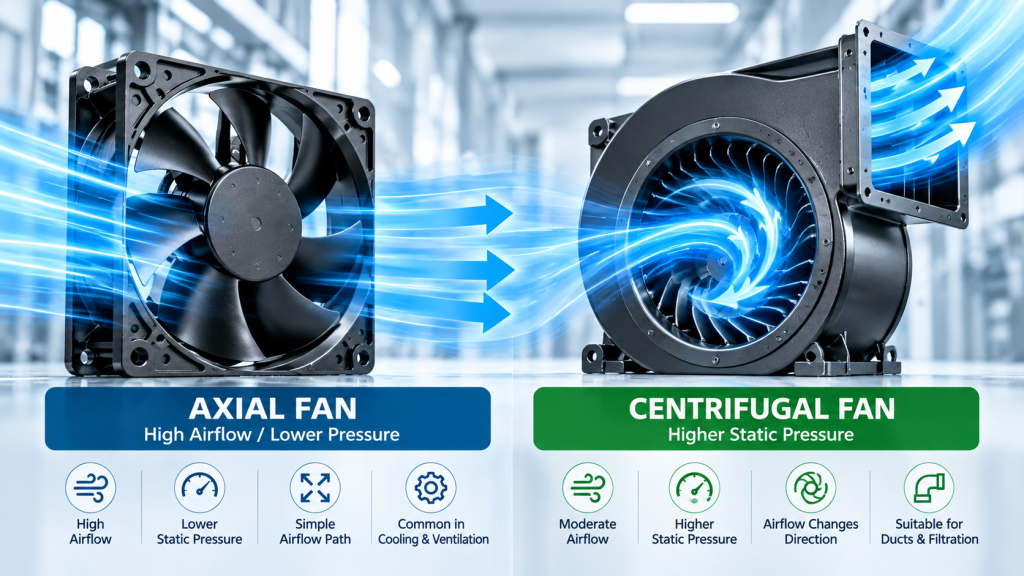
An axial fan moves air in a direction that is generally parallel to the rotating shaft of the fan.
As the impeller rotates, the blades draw air from one side and discharge it along the same general axis.
Because of this relatively direct airflow path, axial fans are commonly used where high airflow is required with relatively low to moderate system resistance.
Typical applications include:
- Equipment cooling
- Cabinet and enclosure ventilation
- HVAC systems
- Industrial machinery
- Heat exchangers
- General ventilation systems
Axial fans are available in many sizes and can use AC, DC or EC motor technologies depending on the application.
What Is a Centrifugal Fan?
A centrifugal fan moves air differently.
Air enters the fan near the center of the impeller and is redirected outward as the impeller rotates. The airflow is then discharged through the fan housing or outlet.
This design allows centrifugal fans to generate higher pressure than many conventional axial fan designs.
For this reason, centrifugal fans are often used in systems where airflow must overcome greater resistance.
Typical applications include:
- Air handling equipment
- Filtration systems
- HVAC equipment
- Industrial ventilation
- Electronic and equipment cooling
- Systems with ducts or restricted airflow paths
Centrifugal designs are particularly useful when the system requires a combination of airflow and higher static pressure.
The Main Difference: Airflow and Static Pressure
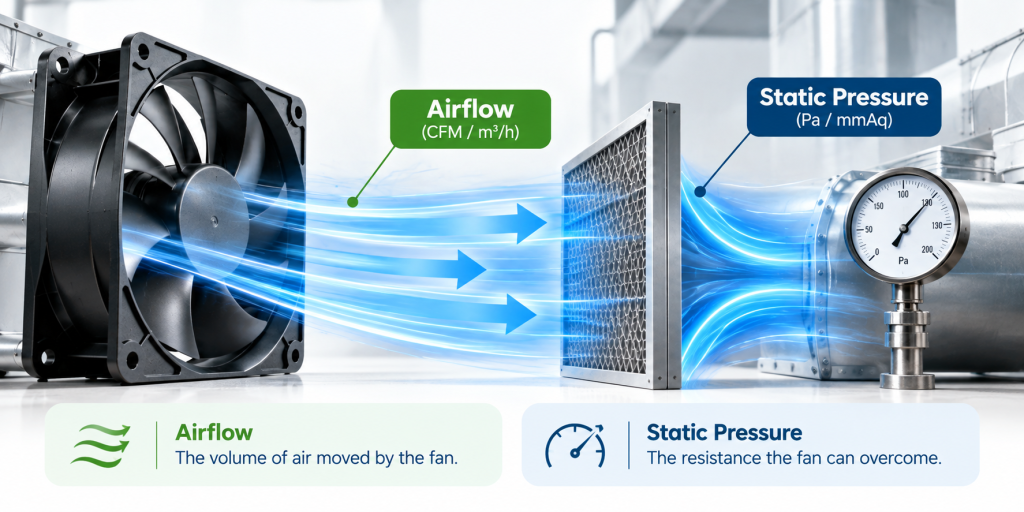
The most important difference between axial and centrifugal fans is how they perform under system resistance.
Axial fans are generally well suited to applications requiring higher airflow with lower pressure requirements.
Centrifugal fans are generally better suited to applications requiring higher static pressure to overcome resistance in the airflow path.
For example, an open ventilation system may have relatively little resistance. In this situation, an axial fan may provide an efficient and straightforward solution.
However, if air must pass through filters, heat exchangers, ducts or other restrictive components, the system resistance increases.
In these applications, a centrifugal fan may provide better performance.
Axial Fan vs. Centrifugal Fan
The general differences can be summarized as follows:
| Characteristic | Axial Fan | Centrifugal Fan |
|---|---|---|
| Airflow Direction | Generally parallel to fan shaft | Air enters axially and is discharged outward |
| Airflow Capability | Typically high | Moderate to high |
| Static Pressure Capability | Low to moderate | Moderate to high |
| Installation | Often compact and straightforward | Depends on fan and housing design |
| Typical Use | Cooling and general ventilation | Higher-resistance airflow systems |
| Common Applications | Equipment cooling, HVAC, ventilation | Filtration, air handling, ducts, industrial systems |
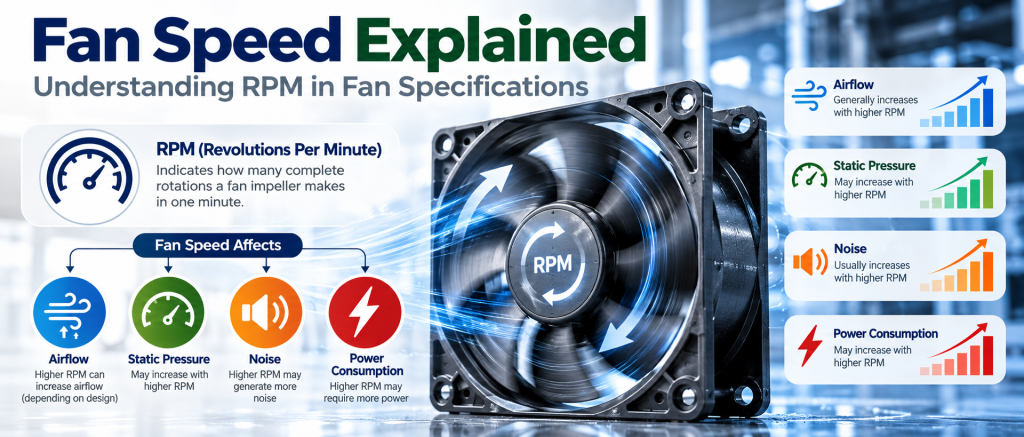
These are general characteristics. Actual performance depends on the fan design, motor, impeller geometry, operating speed and system conditions.
System Resistance Matters
Choosing between an axial fan and a centrifugal fan should not be based only on maximum airflow.
Every ventilation system creates some amount of resistance.
Filters, heat exchangers, ducts, grilles and internal equipment structures can all restrict airflow.
As system resistance increases, the actual airflow produced by a fan may decrease.
This is why static pressure and the fan performance curve should be considered when selecting a fan.
The correct fan should operate near the required airflow and pressure at the actual system operating point.
Which Fan Should You Choose?
An axial fan may be suitable when:
- High airflow is required
- System resistance is relatively low
- Installation space favors a direct airflow path
- The application involves general ventilation or equipment cooling
A centrifugal fan may be more suitable when:
- Higher static pressure is required
- Air must pass through filters or heat exchangers
- The system includes restrictive airflow paths
- The application requires airflow through ducting or internal equipment resistance
However, there is no single fan type that is best for every application.
The correct choice depends on the actual operating conditions of the system.
Consider the Complete Operating Requirement
When selecting a fan, several factors should be evaluated together:
- Required airflow
- Required static pressure
- Available installation space
- Voltage and power supply
- Noise requirements
- Operating temperature
- Speed control requirements
- System resistance
- Required fan dimensions
Evaluating these parameters together provides a more reliable basis for fan selection than comparing airflow specifications alone.
Selecting the Right Fan for Your Application
Axial and centrifugal fans each have advantages depending on the application.
Axial fans are commonly used for efficient high-volume air movement in relatively low-resistance systems, while centrifugal fans are often selected when higher static pressure is required.
The key is to match the fan’s performance characteristics with the actual airflow and pressure requirements of the equipment.
HEYU Technology provides axial, centrifugal, AC, DC and EC fan solutions for a wide range of industrial cooling and ventilation applications.
If you are unsure which fan type is suitable for your equipment, share your airflow, static pressure, dimensions, voltage and operating requirements with us. Our team can help evaluate suitable fan solutions based on your application needs.