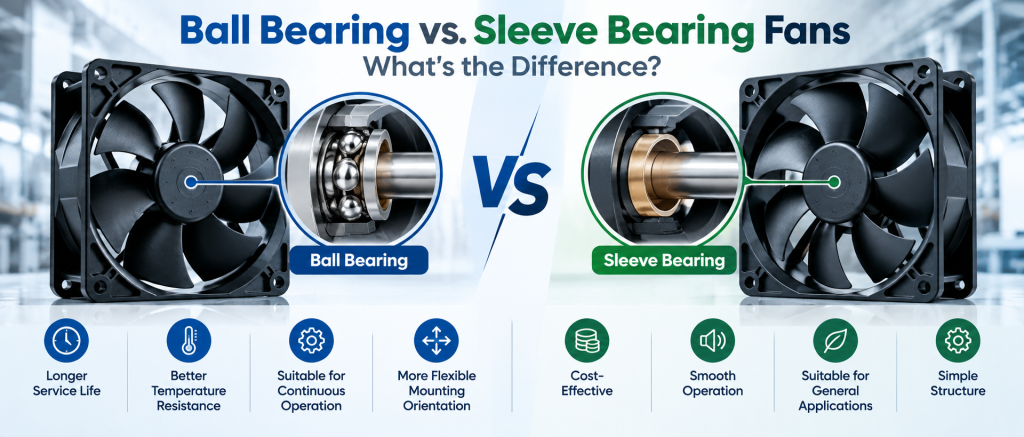
Ball Bearing vs. Sleeve Bearing Fans: What’s the Difference?
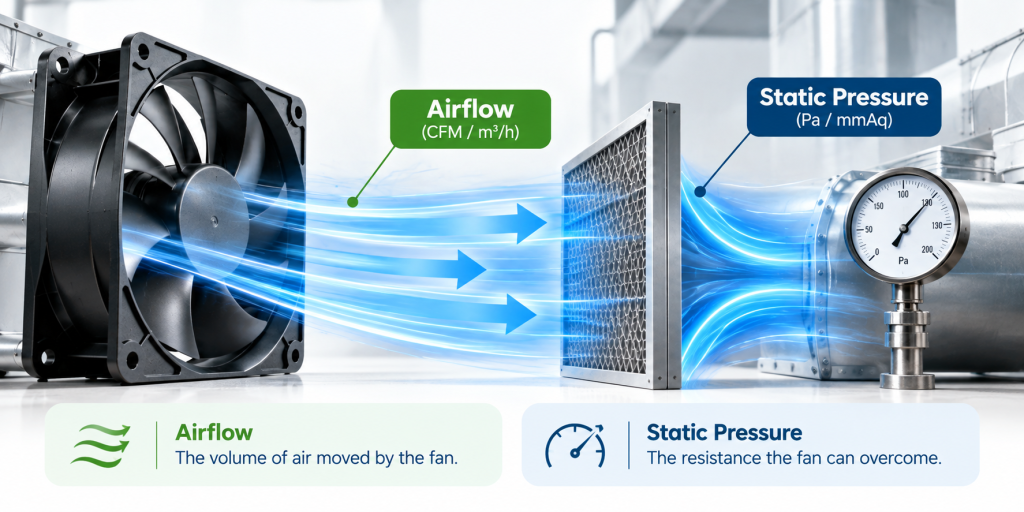
When selecting a cooling or ventilation fan, airflow and static pressure are not the only factors to consider. The type of bearing used inside the fan can also affect its operating characteristics, service life, noise and suitability for different applications.
Two of the most common bearing types used in industrial fans are ball bearings and sleeve bearings.
Both designs can provide reliable operation, but they have different characteristics. Understanding these differences can help engineers select a fan that better matches the operating environment and equipment requirements.
What Is a Ball Bearing Fan?
A ball bearing fan uses small metal balls positioned between the rotating shaft and the bearing races.
As the motor rotates, the balls reduce friction between the moving components and support the shaft during operation.
Ball bearing systems are widely used in industrial cooling and ventilation equipment because they can provide reliable operation under demanding conditions.
Typical advantages of ball bearing fans include:
- Long operating life
- Good durability
- Suitable for continuous operation
- Stable performance at higher operating temperatures
- Greater flexibility in mounting orientation
For these reasons, ball bearing fans are commonly found in industrial equipment, control cabinets, telecommunications equipment, HVAC systems and other applications where long-term reliability is important.
What Is a Sleeve Bearing Fan?
A sleeve bearing uses a cylindrical sleeve surrounding the rotating shaft.
A thin layer of lubricant between the shaft and the sleeve reduces friction and allows the motor to rotate smoothly.
Sleeve bearing systems have a relatively simple mechanical structure and are commonly used in cooling applications where operating conditions are less demanding.
Typical characteristics include:
- Simple bearing structure
- Smooth operation
- Suitable for many general cooling applications
- Often economical for applications that do not require demanding operating conditions
Sleeve bearing fans can therefore be a practical solution for equipment where operating temperature, mounting orientation and service-life requirements are moderate.
Ball Bearing vs. Sleeve Bearing
The main differences can be summarized as follows:
| Factor | Ball Bearing | Sleeve Bearing |
|---|---|---|
| Structure | Ball-and-race bearing system | Shaft supported by lubricated sleeve |
| Durability | Generally higher | Suitable for general applications |
| Operating Temperature | Better suited to demanding temperatures | More dependent on lubrication and operating conditions |
| Mounting Orientation | More flexible | Orientation may affect long-term performance |
| Continuous Operation | Well suited | Depends on application conditions |
| Cost | Generally higher | Generally more economical |
| Typical Applications | Industrial and demanding equipment | General cooling applications |
These differences do not mean that one bearing type is always better than the other. The correct choice depends on how and where the fan will operate.
Why Does Mounting Orientation Matter?
Mounting orientation can influence the behavior of a bearing system.
Ball bearings mechanically support the rotating shaft using bearing races and rolling elements, making them suitable for a wide range of installation orientations.
Sleeve bearings depend more heavily on the relationship between the shaft, sleeve and lubricant. As a result, mounting orientation and operating conditions can influence long-term performance.
For equipment where the fan may be installed in different orientations, this should be considered during fan selection.
How Does Temperature Affect Bearing Selection?
Temperature is another important consideration.
Fans installed inside industrial equipment may operate near motors, power electronics, heat exchangers or other heat-generating components.
Higher temperatures can affect lubricants and bearing performance over time.
For applications involving elevated temperatures or continuous operation, ball bearing fans are often considered because of their durability and operating characteristics.
However, engineers should always check the specified operating temperature range of the actual fan model rather than selecting a fan based only on bearing type.
What About Fan Noise?
Bearing design can influence fan noise, but bearing type is only one factor.
Overall fan noise can also be affected by:
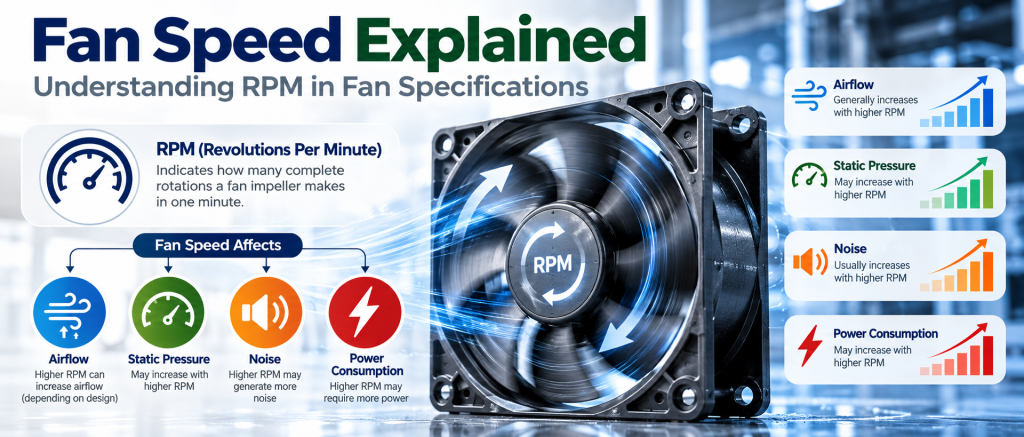
- Fan speed
- Impeller design
- Motor design
- Airflow turbulence
- Installation structure
- System resistance
- Vibration
Therefore, a sleeve bearing fan should not automatically be considered quieter, nor should a ball bearing fan automatically be considered louder.
The actual acoustic specification of the selected fan should be evaluated for noise-sensitive applications.
Which Bearing Type Should You Choose?
A ball bearing fan may be more appropriate when the application requires:
- Long operating life
- Continuous operation
- Higher operating temperatures
- Flexible mounting orientation
- Industrial-duty reliability
A sleeve bearing fan may be suitable when:
- Operating conditions are moderate
- The installation environment is relatively stable
- Cost is an important consideration
- The application does not require demanding temperature or service-life performance
The bearing type should therefore be considered together with airflow, static pressure, fan speed, noise, dimensions, voltage and environmental requirements.
Selecting the Right Fan for Your Application
Bearing type is only one part of fan selection.
A fan that uses a suitable bearing system but cannot provide the required airflow or static pressure will still not perform correctly in the application.
For industrial equipment, engineers should evaluate the complete operating requirements, including:
Airflow → Static Pressure → Fan Performance Curve → Fan Type → Motor Technology → Dimensions → Noise → Operating Environment → Bearing → Control Requirements
By considering these parameters together, engineers can select a fan that better matches the actual operating conditions of the equipment.
HEYU Technology provides AC, DC and EC fan solutions for a wide range of industrial cooling and ventilation applications.
If you are unsure which fan or bearing type is suitable for your equipment, share your airflow, static pressure, dimensions, voltage and operating requirements with us. Our team can help evaluate suitable fan solutions based on your application needs.