How to Read a Fan Performance Curve
Selecting the right fan involves more than checking its maximum airflow. In actual equipment, airflow changes depending on the resistance within the system.
This is why fan performance curves are important.
A fan performance curve shows the relationship between airflow and static pressure, helping engineers understand how a fan is likely to perform under different operating conditions. By reading the curve correctly, you can compare different fans and identify a suitable solution for your application.
What Is a Fan Performance Curve?
A fan performance curve is a graph that represents how a fan performs across a range of operating conditions.
The two most important parameters are typically:
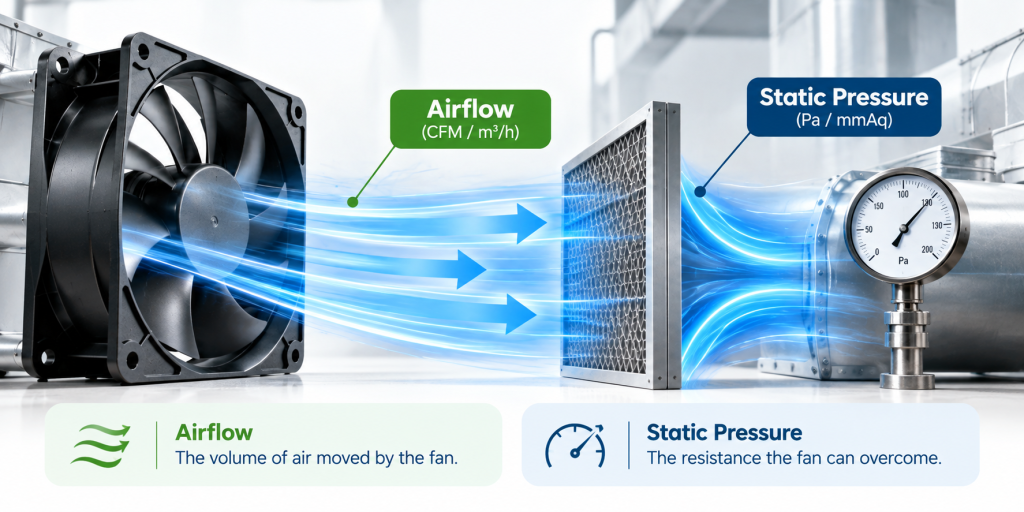
- Airflow – the volume of air moved by the fan, commonly expressed in CFM or m³/h.
- Static Pressure – the pressure the fan must overcome to move air through system resistance, commonly expressed in Pa or mmAq.
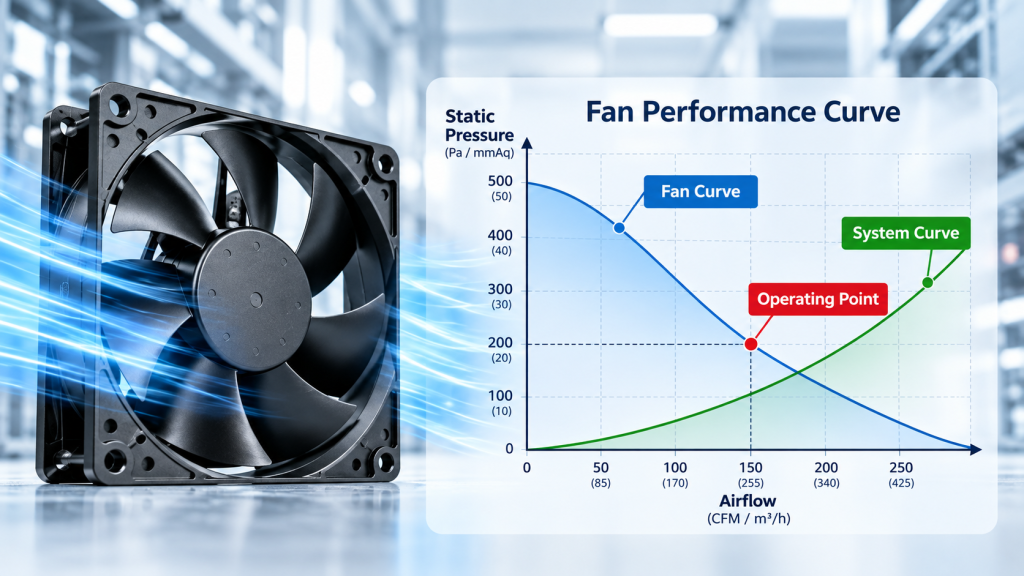
On a typical fan performance curve, airflow is shown on the horizontal axis, while static pressure is shown on the vertical axis.
The curve illustrates how much airflow the fan can provide at different levels of static pressure.
Why Does Airflow Change with Static Pressure?
A fan does not normally deliver the same airflow under every operating condition.
When there is little resistance in the airflow path, the fan can move a relatively large volume of air. As system resistance increases, the fan must generate more pressure to move air through the system.
As a result, the available airflow generally decreases.
For example, components such as filters, heat exchangers, ducts, grilles and other internal structures can all create resistance to airflow.
This means that the maximum airflow shown in a fan specification does not necessarily represent the airflow that will be available after the fan is installed in actual equipment.
Understanding Maximum Airflow
Maximum airflow is typically measured when the fan operates with very little external resistance.
This value is useful for comparing the basic airflow capability of different fans, but it should not be used as the only factor when selecting a fan.
Consider two fans with similar maximum airflow.
At low static pressure, their performance may appear very similar. However, as system resistance increases, one fan may maintain significantly more airflow than the other.
For applications with filters, ducts or other restrictive components, this difference can have a major impact on cooling or ventilation performance.
This is why the complete performance curve is more useful than looking only at the maximum airflow value.
Understanding Maximum Static Pressure
At the other end of the performance curve is maximum static pressure.
This represents the pressure the fan can generate when airflow approaches zero.
Maximum static pressure provides useful information about the pressure capability of a fan, but just like maximum airflow, it does not normally represent the actual operating condition of the system.
Most fans operate somewhere between maximum airflow and maximum static pressure.
The actual operating condition depends on both the characteristics of the fan and the resistance of the system.
What Is the Operating Point?
The actual performance of a fan inside equipment is often described by its operating point.
The operating point represents the combination of airflow and static pressure at which the fan actually operates.
In a complete system analysis, this point can be determined by comparing two curves:
- Fan Performance Curve
- System Resistance Curve
The fan curve shows what the fan can provide, while the system curve represents the resistance created by the equipment.
Where these two curves intersect is the operating point.
This point indicates the approximate airflow and static pressure that can be expected under those system conditions.
What Is a System Resistance Curve?
System resistance increases as airflow through the equipment increases.
Filters, heat exchangers, ducts, vents, protective grilles and internal components all contribute to this resistance.
For example, an open ventilation system may have relatively low resistance. A system that forces air through a dense filter or heat exchanger may have much higher resistance.
Because every equipment design is different, the same fan can operate at different airflow levels when installed in different systems.
Understanding system resistance is therefore an important part of fan selection.
How to Compare Fans Using Performance Curves
When comparing two fans, avoid looking only at their maximum airflow values.
Instead, identify the approximate static pressure required by your application and compare how much airflow each fan can provide at that pressure.
For example, Fan A and Fan B may both provide similar maximum airflow under free-air conditions.
However, if Fan B maintains higher airflow as static pressure increases, it may be more suitable for an application with significant airflow resistance.
The better fan is not necessarily the fan with the highest maximum specification. It is the fan whose performance curve best matches the requirements of the system.
Factors That Can Affect Actual Fan Performance
Several factors can influence the actual operating point of a fan:
- Air filters
- Heat exchangers
- Duct length and geometry
- Air inlet and outlet restrictions
- Protective grilles
- Internal equipment layout
- Fan installation position
- System airflow resistance
Changes to these components can change the resistance of the system and therefore change the actual airflow delivered by the fan.
This is particularly important when designing industrial equipment where cooling and ventilation performance must remain reliable under real operating conditions.
Selecting the Right Fan for Your Application
A fan performance curve provides a much more complete picture of fan capability than a single airflow specification.
When selecting a fan, consider the required airflow together with static pressure, available installation space, voltage, noise requirements and operating environment.
For applications with significant system resistance, performance at the expected operating point is often more important than maximum airflow.
The goal is not simply to choose the fan with the highest airflow or static pressure. The goal is to select a fan whose performance characteristics match the actual requirements of the equipment.
HEYU Technology provides AC, DC and EC fan solutions for a wide range of industrial cooling and ventilation applications.
If you are evaluating a fan for your equipment, share your airflow, static pressure, dimensions, voltage and operating requirements with us. Our team can help evaluate suitable fan solutions based on your application needs.