Understanding Fan IP Ratings: What IP54, IP55 and IP68 Mean
When selecting a fan for industrial equipment, airflow, static pressure and fan size are not the only factors to consider. The operating environment can also have a significant impact on fan reliability and service life.
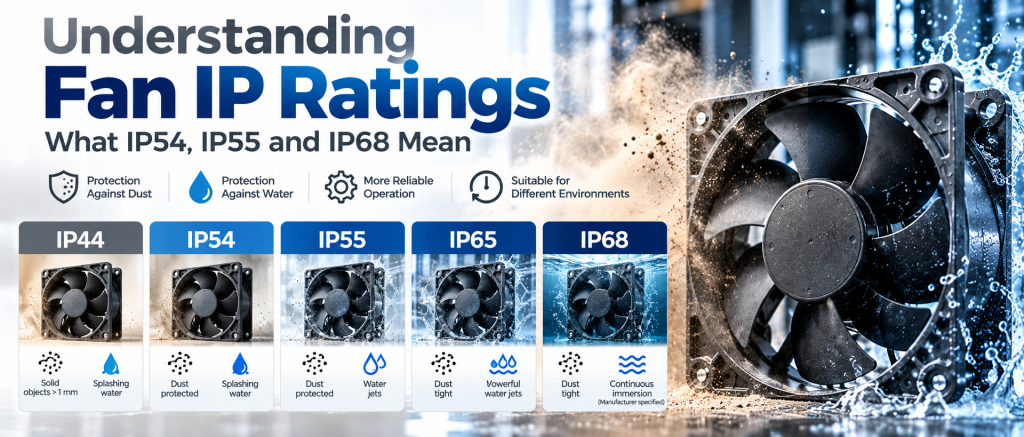
Fan IP ratings indicate the level of protection provided against solid particles and water. Understanding these ratings can help engineers select a fan that is suitable for the actual operating environment.
What Is an IP Rating?
IP stands for Ingress Protection.
An IP rating is normally expressed using two numbers, such as:
IP54
The first digit indicates the level of protection against solid objects and dust, while the second digit indicates the level of protection against water.
For example:
IP5X indicates a level of protection against dust.
IPX4 indicates protection against splashing water.
Together, IP54 describes the enclosure’s protection against both solid particles and water ingress.
Understanding the First Digit: Solid Protection
The first digit of an IP rating represents protection against solid objects.
For industrial fan applications, the most relevant higher levels are typically:
5 – Dust Protected
Dust may enter in limited quantities, but not enough to interfere with normal operation.
6 – Dust Tight
The enclosure provides complete protection against dust ingress under the specified test conditions.
This can be important when fans operate in environments where dust or other airborne particles are present.
Understanding the Second Digit: Water Protection
The second digit indicates the level of protection against water.
Some commonly encountered levels include:
4 – Splashing Water
Protection against water splashing from different directions.
5 – Water Jets
Protection against water projected by jets.
6 – Powerful Water Jets
Protection against stronger water jets.
7 – Temporary Immersion
Protection against temporary immersion under specified conditions.
8 – Continuous Immersion
Protection under immersion conditions specified by the manufacturer.
The appropriate level depends on where and how the fan will be installed.
What Does IP54 Mean for a Fan?
An IP54 fan provides dust protection together with protection against splashing water.
This type of protection can be suitable for many industrial equipment applications where the fan may encounter dust or occasional moisture but is not expected to operate under severe water exposure.
However, the IP rating should always be considered together with the actual installation conditions.
IP54 vs. IP55
IP54 and IP55 have the same first digit, so both provide the same dust-protection classification.
The difference is the second digit.
IP54 provides protection against splashing water.
IP55 provides protection against water jets.
Therefore, IP55 may be appropriate where equipment could experience greater exposure to water.
This does not automatically mean that IP55 is the better choice for every application. The required protection level should match the actual operating environment.
What About IP65?
An IP65 enclosure provides a higher level of protection against both dust and water.
The first digit, 6, indicates dust-tight protection, while the second digit, 5, indicates protection against water jets.
Fans with this level of protection may be considered for applications involving more demanding environmental conditions.
However, engineers should still verify the complete fan specification rather than selecting a product based only on its IP rating.
What Does IP68 Mean?
IP68 represents a high level of protection against dust and water ingress.
The first digit, 6, indicates dust-tight protection.
The second digit, 8, indicates protection under continuous immersion conditions specified by the manufacturer.
An important point is that IP68 does not describe one universal immersion depth or duration for every product. The exact test and operating conditions should be confirmed from the manufacturer’s specifications.
Does a Higher IP Rating Always Mean a Better Fan?
Not necessarily.
A higher IP rating indicates a higher level of ingress protection, but that does not automatically make the fan more suitable for every application.
Fan selection also depends on factors such as:
- Airflow requirements
- Static pressure
- Fan dimensions
- Voltage and motor technology
- Noise requirements
- Operating temperature
- Speed control requirements
- Installation conditions
For equipment installed in a clean and controlled indoor environment, a very high IP rating may provide little practical benefit.
The goal is to select a protection level that matches the actual environment.
Why Fan IP Ratings Matter
Industrial fans can operate in very different conditions.
A fan installed inside electronic equipment may operate in a relatively clean environment, while a fan used in industrial machinery, ventilation equipment or outdoor systems may encounter considerably more dust and moisture.
Selecting an appropriate IP rating can help reduce the risk of environmental contaminants affecting fan operation.
This is particularly important when equipment is expected to operate continuously or in demanding industrial environments.
Selecting the Right Fan for Your Application
The IP rating should be treated as one part of the overall fan selection process.
Before selecting a fan, consider the complete application requirements, including airflow, static pressure, dimensions, electrical requirements, operating temperature, noise and environmental protection.
The best fan is not necessarily the one with the highest IP rating. It is the fan whose performance and protection characteristics match the requirements of the equipment.
HEYU Technology provides AC, DC and EC fan solutions for a wide range of industrial equipment and ventilation applications.
If you are unsure which fan is suitable for your application, share your airflow, static pressure, dimensions, voltage and operating environment requirements with us. Our team can help evaluate suitable fan solutions based on your application needs.