Airflow and static pressure are two of the most important parameters when selecting a cooling or ventilation fan. Although they are closely related, they describe two different aspects of fan performance.
Understanding the difference between airflow and static pressure can help engineers select the right fan for an application and avoid common problems such as insufficient cooling, reduced airflow, or excessive noise.
What Is Airflow?
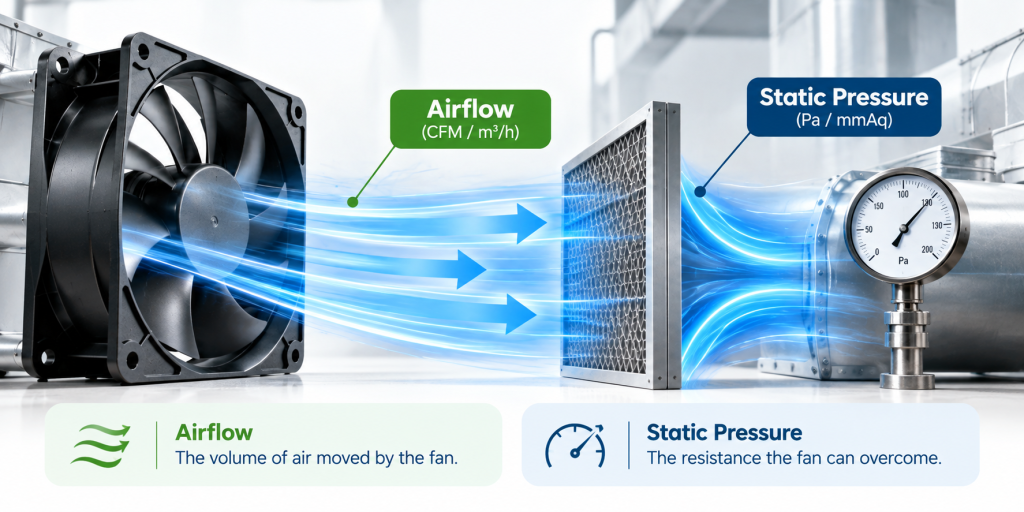
Airflow describes the volume of air that a fan can move within a certain period of time.
Common units include:
- CFM (Cubic Feet per Minute)
- m³/h (Cubic Meters per Hour)
- m³/min (Cubic Meters per Minute)
In simple terms, higher airflow means that a fan can move a larger volume of air.
Airflow is particularly important in applications where the primary purpose of the fan is to exchange, circulate, or remove large volumes of air, such as equipment ventilation, HVAC systems, electrical cabinets, and general industrial ventilation.
However, the maximum airflow shown in a fan specification does not necessarily represent the airflow that will actually occur after the fan is installed in equipment.
What Is Static Pressure?
Static pressure represents a fan’s ability to overcome resistance to airflow.
Depending on the datasheet, static pressure may be expressed in units such as:
- Pa (Pascal)
- mmAq (mmH₂O)
- inH₂O
When air passes through components such as filters, heat sinks, ducts, grilles, heat exchangers, or other restricted passages, resistance is created.
The fan must generate sufficient pressure to overcome this resistance and maintain the required airflow.
This is why a fan with high maximum airflow is not automatically the best choice for every application.
Airflow vs. Static Pressure
A useful way to understand the difference is:
Airflow tells you how much air the fan can move, while static pressure tells you how effectively the fan can move air against resistance.
For example, consider two different applications.
An open ventilation system with very little restriction may benefit from a fan capable of delivering high airflow.
In contrast, an application where air must pass through a dense filter, heat exchanger, long duct, or restrictive internal structure may require a fan capable of maintaining higher static pressure.
The correct fan therefore depends on the actual operating environment rather than airflow alone.
Why Does Airflow Decrease When Resistance Increases?
Fan performance changes according to system resistance.
When there is little resistance, a fan can normally deliver relatively high airflow. As resistance increases, the airflow delivered by the fan decreases.
This relationship is typically shown on a fan performance curve, often referred to as a P-Q curve.
The curve illustrates the relationship between:
- Airflow (Q)
- Static Pressure (P)
At one end of the curve, the fan reaches its maximum airflow under very low resistance.
At the other end, the fan reaches its maximum static pressure when airflow approaches zero.
In actual equipment, the fan normally operates somewhere between these two conditions.
Why the Operating Point Matters
Selecting a fan only by comparing maximum airflow values can be misleading.
In a real system, components such as filters, ducts, heat sinks, protective grilles, and internal equipment structures create airflow resistance.
This resistance can be represented by a system resistance curve.
The point where the fan performance curve intersects the system resistance curve is known as the operating point.
This operating point represents the approximate airflow and static pressure the fan will deliver when installed in the actual system.
For this reason, evaluating the operating point is more useful than simply comparing maximum airflow specifications.
High Airflow or High Static Pressure?
The answer depends on the application.
Applications with relatively low airflow resistance generally place greater emphasis on airflow. Examples may include open ventilation, cabinet ventilation, and general air circulation.
Applications with higher resistance may require greater static pressure capability. Examples may include:
- Air filtration systems
- Heat exchangers
- Dense heat sinks
- Long or narrow air ducts
- Air purification equipment
- Industrial equipment with restricted airflow paths
In some applications, both airflow and static pressure are important and must be evaluated together.
Fan Type Also Matters
Different fan designs provide different airflow and pressure characteristics.
Axial fans are widely used where relatively high airflow is required within a compact installation space.
Centrifugal fans and blowers are often considered when an application requires airflow to overcome greater system resistance.
However, fan type alone should not determine the final selection. Size, speed, motor technology, noise requirements, operating environment, airflow path, and system resistance should also be considered.
Choosing the Right Fan for Your Application
When selecting the right fan for your application, consider the complete operating conditions rather than focusing on a single specification.
Important factors may include:
- Required airflow
- Required static pressure
- Available installation space
- System resistance
- Operating voltage
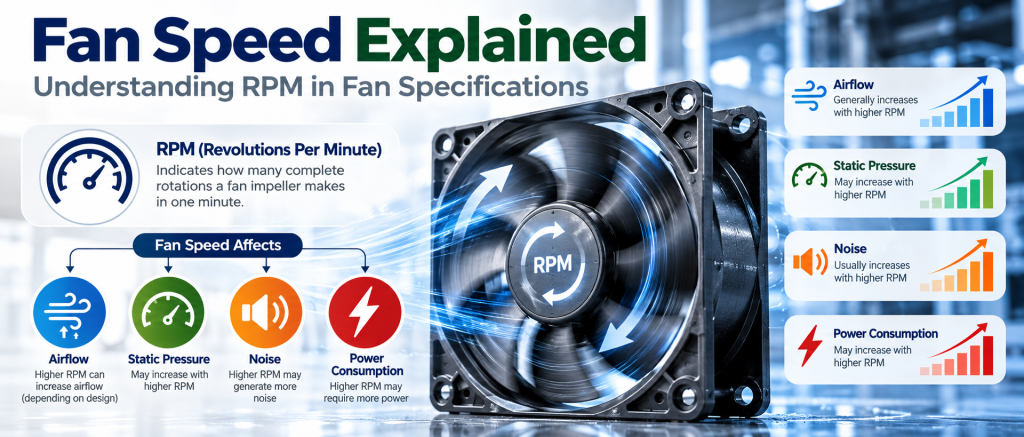
- Fan speed
- Noise requirements
- Ambient temperature
- Airflow direction
- Speed control requirements
- Expected operating environment
Understanding these requirements makes it easier to identify a fan that can operate effectively within the actual system.
Conclusion
Airflow and static pressure are closely connected, but they represent different aspects of fan performance.
Airflow describes how much air a fan can move. Static pressure describes the fan’s ability to move that air against resistance.
For industrial cooling and ventilation applications, the best fan is not necessarily the one with the highest airflow or the highest static pressure. The goal is to select a fan whose performance characteristics match the actual requirements of the system.
HEYU Technology provides AC, DC and EC fan solutions for a wide range of industrial equipment and ventilation applications.
If you are unsure which fan is suitable for your application, share your airflow, static pressure, dimensions, voltage and operating requirements with us. Our team can help evaluate suitable fan solutions based on your application needs.